

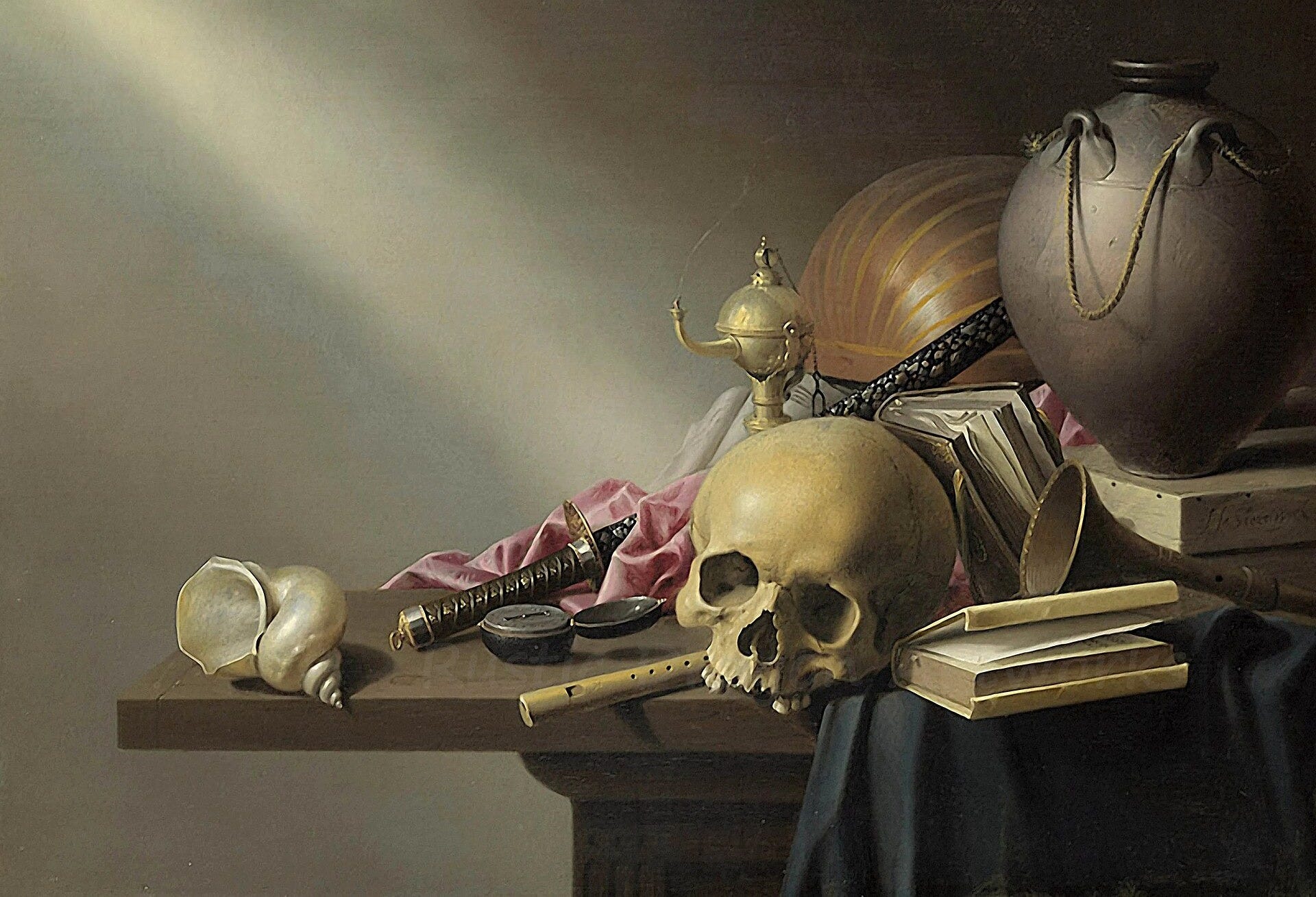
We don’t talk about death in a meaningful way anymore — and this is historically strange.
For most of Western Civilization, death was out in the open, visible to peasant, prince, and child alike. It was deliberately exposed to society as a means of teaching and wisdom. The skull on the philosopher’s desk, the hourglass on the painter’s table, and the ashes pressed into the forehead on Ash Wednesday were not expressions of a culture simply obsessed with the macabre. Instead, they were reminders of our limitations, our natural mortality.
The tradition that produced them was convinced that a life lived in awareness of its own ending was a better life than one lived in denial of it. Memento mori — remember your death — was actually an invitation to live with clarity and purpose…
Reminder: You can support us in forming minds and rebuilding the West by unlocking our members-only content:
✔️ Full premium articles every Tuesday + Free content Thursdays
✔️ The entire archive: Western history, literature, and culture
✔️ The Great Books lists (Hundreds of titles that influenced Western thought)
Join to start reading and support the mission today 👇
The Stoics
The phrase itself is Latin, and its origins are curiously institutional rather than philosophical. In accounts of the Roman triumph (a military victory parade), a slave would stand behind the successful general during the procession and remind him, from time to time, of his own mortality. At the height of his glory, surrounded by cheering crowds and the spectacle of conquest, the most powerful man in Rome was made to hear the words: remember, you will die. The reminder was built into the ceremony itself, because the Romans understood that a man is most tempted to forget his limits when on the heels of a great victory.
The Stoic philosophers habitualized what the Roman army acted out post-victory. Seneca, writing to his friend Lucilius, urged:
“Let us prepare our minds as if we’d come to the very end of life. Let us postpone nothing. Let us balance life’s books each day.”
Similarly, Marcus Aurelius, running an empire from a military camp on the Danube, wrote to himself in private:
“You could leave life right now. Let that determine what you do and say and think.”
For Seneca and Marcus Aurelius, the daily contemplation of death wasn’t pessimism. Regular contemplation of mortality was an antidote to procrastination and a motivation to action. If you believe death may fall upon you in the night, you would be wise not to waste the afternoon. You’ll also find yourself concerned with meaningful action, careful speech, and guarded thoughts.
Because the mind naturally drifts away from uncomfortable truths toward distraction, the Stoics viewed the contemplation of death as an act of the will, a discipline requiring daily effort. The memento mori corrects the passive slide into vices, especially sloth and pride. It compelled the Stoics to consider each day as potentially their last, giving them an urgency to live virtuously.
Memento Mori in Art
It should come with little surprise that when Renaissance artists looked back to the Romans, they picked up on the theme of the memento mori. The Renaissance welcomed death as a visual contemplation on our mortality for nearly three centuries.
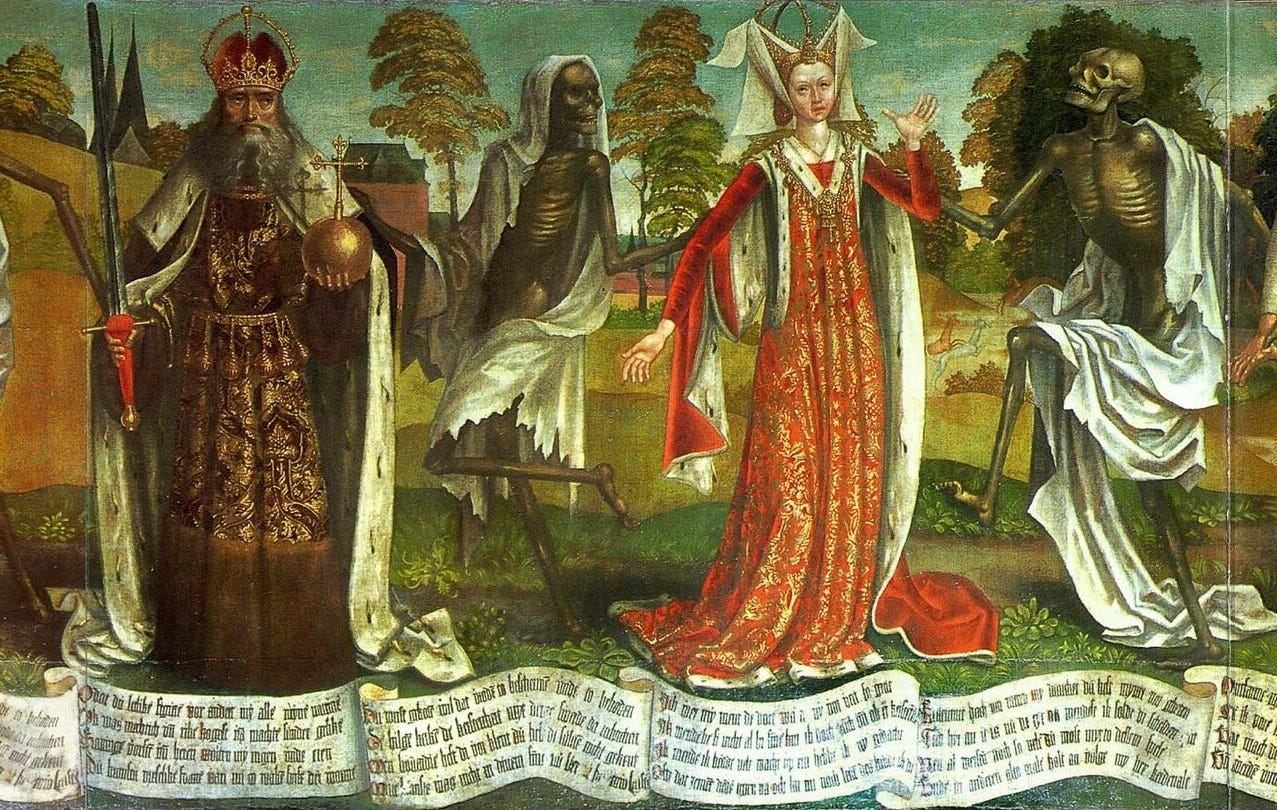
But the memento mori first made its way into Medieval art through the Danse Macabre where Death appeared as a skeleton and danced with popes, emperors, merchants, peasants — even children. The imagery appeared on church walls across Europe, largely spurred by the grim events of the Black Death. The Grim Reaper, the hooded scythe-wielding figure of Death in, developed out of a darker 19th century take on Danse Macabre art.
The memento mori gained great popularity with the Renaissance artists, who, with centuries of Medieval backdrop to draw from, settled the skull naturally into scenes of learning and sanctity. The skull wasn’t used as a symbol for horror and fear as it is today, but rather as the philosopher’s or the saint’s companion, as the more piercing symbol of life’s finiteness than the benign hourglass.
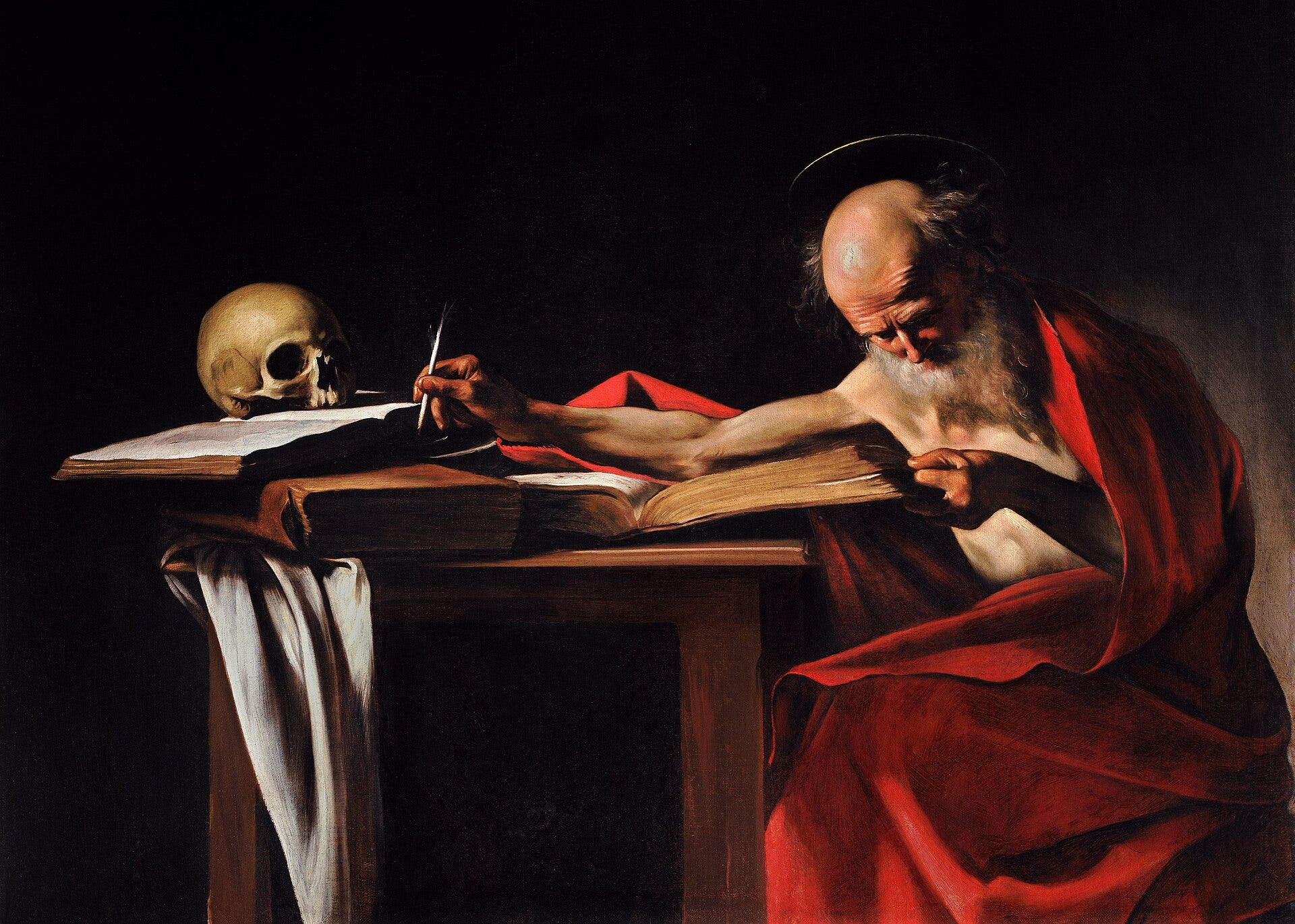
St. Jerome, the great scholar of the early Church who translated the Bible into Latin, was among the most painted saints of the Renaissance and Baroque periods, and he often appeared with a skull nearby. Caravaggio’s Saint Jerome Writing places the skull directly on the saint’s desk, its profile deliberately counterbalancing Jerome’s own aged head. Beyond it reflecting merely the holy disposition of St. Jerome, however, it also reminds us of the gravity and longevity of his work — translation of the Latin Vulgate — that would long outlast himself.
In 1521, Dürer painted St. Jerome in his study surrounded by objects symbolizing transience — the skull, a snuffed-out candle, and a piece of paper tacked to the wall reading Respice Finem: consider the end. The painting was a sensation, and the type became a specialty of local workshops, spawning dozens of versions across Northern Europe.
St. Francis of Assisi was treated similarly across generations of painters, from Zurbarán to Guido Reni. The skull in Franciscan iconography carried specific theological weight because Francis himself called death his “sister,” and Franciscan sources consistently described death as the doorway to life. The skull on his desk reflected the Christian belief that death was not an end but rather a passage.
With the Enlightenment’s detraction from Christianity, Dutch painters of the seventeenth century took this further by removing the saints and letting the objects speak for themselves. A sputtering candle, half-eaten food, an hourglass — all gentle reminders of finitude. But somewhere among these objects would still rest the skull. Often these still paintings contrasted the beauty of fine tables and trinkets against the naked skull, emphasizing the futility of worldly possessions.
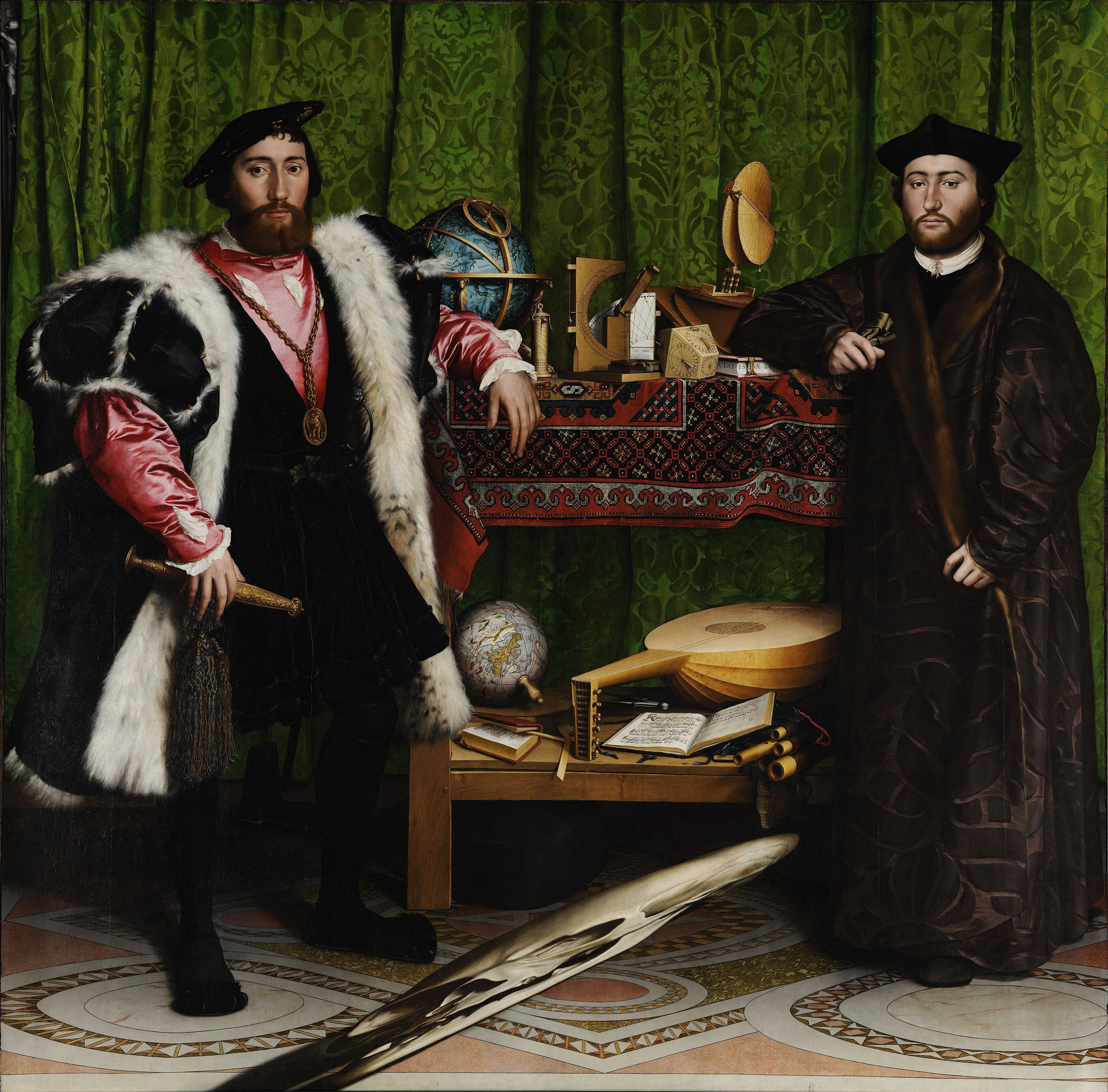
Holbein made a similar argument with particular brilliance in The Ambassadors, where a distorted skull stretches across the bottom of the canvas, visible only when viewed from an oblique angle. Death was in plain sight, but only comprehensible from the right angle, or in my own interpretation, the right theology.
The Church’s Reminder
No institution in Western history has done more to keep death visible than the Catholic Church. And it did so for theology rather than morbidity, because a faith hinging on death and resurrection can’t hide death away.
Christianity’s early history was naturally close to death. Aside from the obvious death and resurrection of Jesus, the early Christians were persecuted and killed for their Christian faith at certain junctures in their first four centuries. Often, to skirt death above, Christians worshiped among the dead below — in the catacombs surrounded by images of resurrection — fish, bread, the raising of Lazarus.
To many outsiders, the Christians likely appeared obsessed with death in a strange way. They eventually took up a method of Roman execution — the cross — as the central symbol of their faith, while their liturgies were full of the language of sacrifice. Christianity thus bears a duality of attitudes: a solemn knowledge of death but joyous hope in resurrection.
The liturgical calendar encoded this conviction into the rhythms of ordinary life. Once a year, on a Wednesday at the start of Lent, Christians come forward to receive ashes on the forehead and hear the words drawn from Genesis: “Remember, man, that you are dust, and to dust you shall return.” All receive the same public mark, as far back as the 13th century. The Bishop of Rome — the most powerful figure in Western Christendom — bowed his head to receive the same ashes and hear the same words as every peasant in every parish. It became a tradition for the popes to receive ashes at the Basilica of Santa Sabina on Aventine Hill. The Ash Wednesday form of memento mori flattened Church hierarchy for a moment, reminding all that death and judgement were impartial.
The Church’s treatment of death runs still deeper in its liturgical imagination: whenever it celebrates a saint’s feast day, it celebrates the dies natalis — the day of their birth into heaven, which is to say, the day they died. In this inversion lies a fundamental Christian theology: death is not the end of the story but its decisive turning point, the threshold of Heaven.
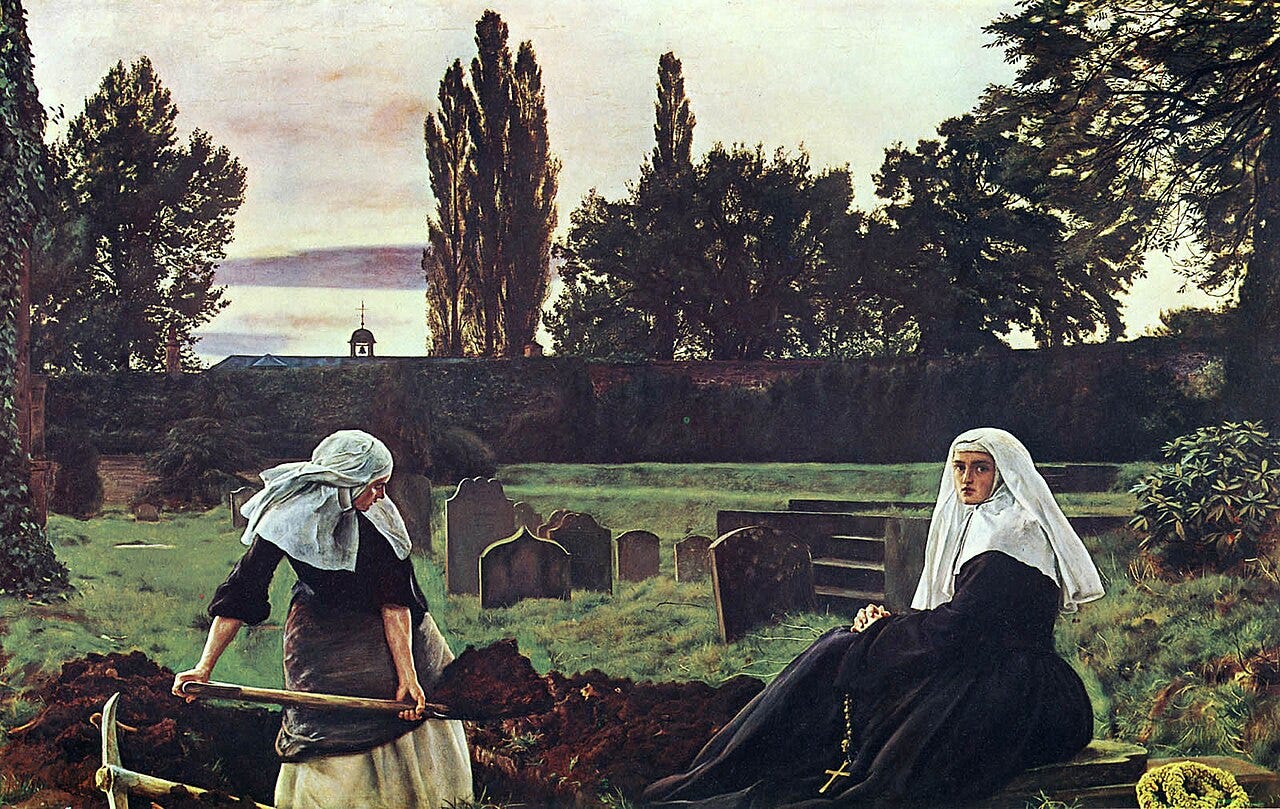
Among written works, the Ars Moriendi — the art of dying well — was among the most widely circulated texts of the medieval period. It was a practical guide to preparing for death that was read by ordinary Christians who understood that dying well required preparation and practice. St. Alphonsus Liguori extended this tradition into the 18th century with his Preparation for Death, a sustained meditation on mortality as a spiritual discipline.
The overarching premise of these saints, liturgies, and practices was that the person who has thought seriously about death is more capable of living well than the person who has not. Ecclesiastes recognized long ago the urgency that death forces upon life:
“Remember also your Creator in the days of your youth, . . . before the dust returns to the earth as it was, and the spirit returns to God who gave it.” (Eccl. 12:1-7)
But much of what we used to know, we have since forgotten, especially on subject of death…
